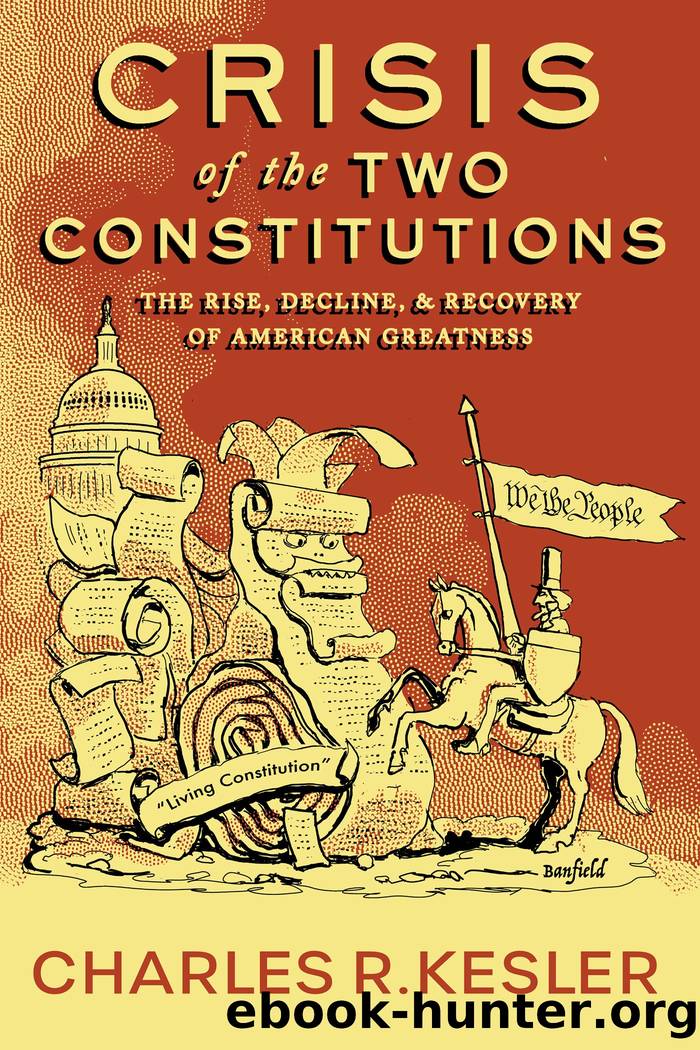
Crisis of the Two Constitutions: The Rise, Decline, and Recovery of American Greatness by Charles R. Kesler
Author:Charles R. Kesler [Kesler, Charles R.]
Language: eng
Format: epub
Publisher: Encounter Books
Published: 2020-05-15T05:00:00+00:00
HISTORY AND THEORY
Although this style of objection comes today from the Left, its political origins in America go back to the antebellum defense of slavery, when Stephen A. Douglas, for instance, argued that the human equality proclaimed in the Declaration of Independence did not apply to all men, but only to white men. This was how the signers of the Declaration had understood it, he claimed, against considerable, indeed massive, evidence to the contrary. Nonetheless, he insisted that âthis Government was established on the white basis. It was made by white men, for the benefit of white men and their posterity forever, and never should be administered by any except white men.â7 This was the real thing: white supremacy. Why the contemporary Left, or important parts of it, should be embracing (as historically correct though repugnant) a view of the Constitution originally propounded by the defenders of black slavery is an interesting question. It has much to do with the historicist temptation, the tendency to believe that everyone is a child of his times and that, for the children of any given time and culture, âwhatever is, is good.â How could eighteenth-century Americans, living amid many âilliberal, undemocratic traditions of ascriptive Americanism,â including Negro slavery, not believe wholeheartedly in these traditions?
This is a temptation shared by some on the traditionalist Right as well. Willmoore Kendall, for example, the Yale political scientist who served as an original senior editor of National Review, delighted in arguing that equality, as an abstract political principle, had little to do with American life as it had actually been lived from the Mayflower Compact up to the Civil War, when, in his view, Abraham Lincoln âderailedâ the American political tradition by turning abstract equality into its goal. Here is Kendall on the real meaning of equality in America:
âEvery Frenchman,â Charles de Gaulle has written somewhere, âwants a special privilege or two; that is how he expresses his passion for Equality.â âEvery American,â I suppose an equally cynical observer here in the United States might say, âwants a right or two that he is by no means willing to concede to everybody else; that is how the American expresses his passion for Equality.â8
American life as it had actually been lived, Kendall insisted, was a tradition rife with inequality, expressed in racial segregation, denial of voting rights, malapportioned legislative districts, local mixtures of church and state, and the like. Whereas the Left despised these âIlliberal, undemocratic traditions,â Kendall liked or at least defended them as examples of good, old-fashioned American constitutionalism, which he defined as âdeliberativeâ but otherwise unprincipled majoritarianism.
On the Left and Right, then, one can find important thinkers prepared (albeit for different reasons) to baptize racist and other unsavory American traditions as authoritative expressions of American principles. One difficulty with so readily turning history into theory â identifying historical practice with organic political principle â is that it underestimates the permeability of tradition, or in other words, the ability of human beings to use their reason in order to change a tradition.
Download
This site does not store any files on its server. We only index and link to content provided by other sites. Please contact the content providers to delete copyright contents if any and email us, we'll remove relevant links or contents immediately.
| Anthropology | Archaeology |
| Philosophy | Politics & Government |
| Social Sciences | Sociology |
| Women's Studies |
The Secret History by Donna Tartt(19352)
The Social Justice Warrior Handbook by Lisa De Pasquale(12253)
Thirteen Reasons Why by Jay Asher(9036)
This Is How You Lose Her by Junot Diaz(6984)
Weapons of Math Destruction by Cathy O'Neil(6384)
Zero to One by Peter Thiel(5889)
Beartown by Fredrik Backman(5870)
The Myth of the Strong Leader by Archie Brown(5569)
The Fire Next Time by James Baldwin(5536)
How Democracies Die by Steven Levitsky & Daniel Ziblatt(5286)
Promise Me, Dad by Joe Biden(5201)
Stone's Rules by Roger Stone(5143)
A Higher Loyalty: Truth, Lies, and Leadership by James Comey(5030)
100 Deadly Skills by Clint Emerson(4983)
Rise and Kill First by Ronen Bergman(4853)
Secrecy World by Jake Bernstein(4819)
The David Icke Guide to the Global Conspiracy (and how to end it) by David Icke(4789)
The Doomsday Machine by Daniel Ellsberg(4573)
The Farm by Tom Rob Smith(4566)
